2025, Amherst
Lorenzo Lotto’s Allegory of Chastity
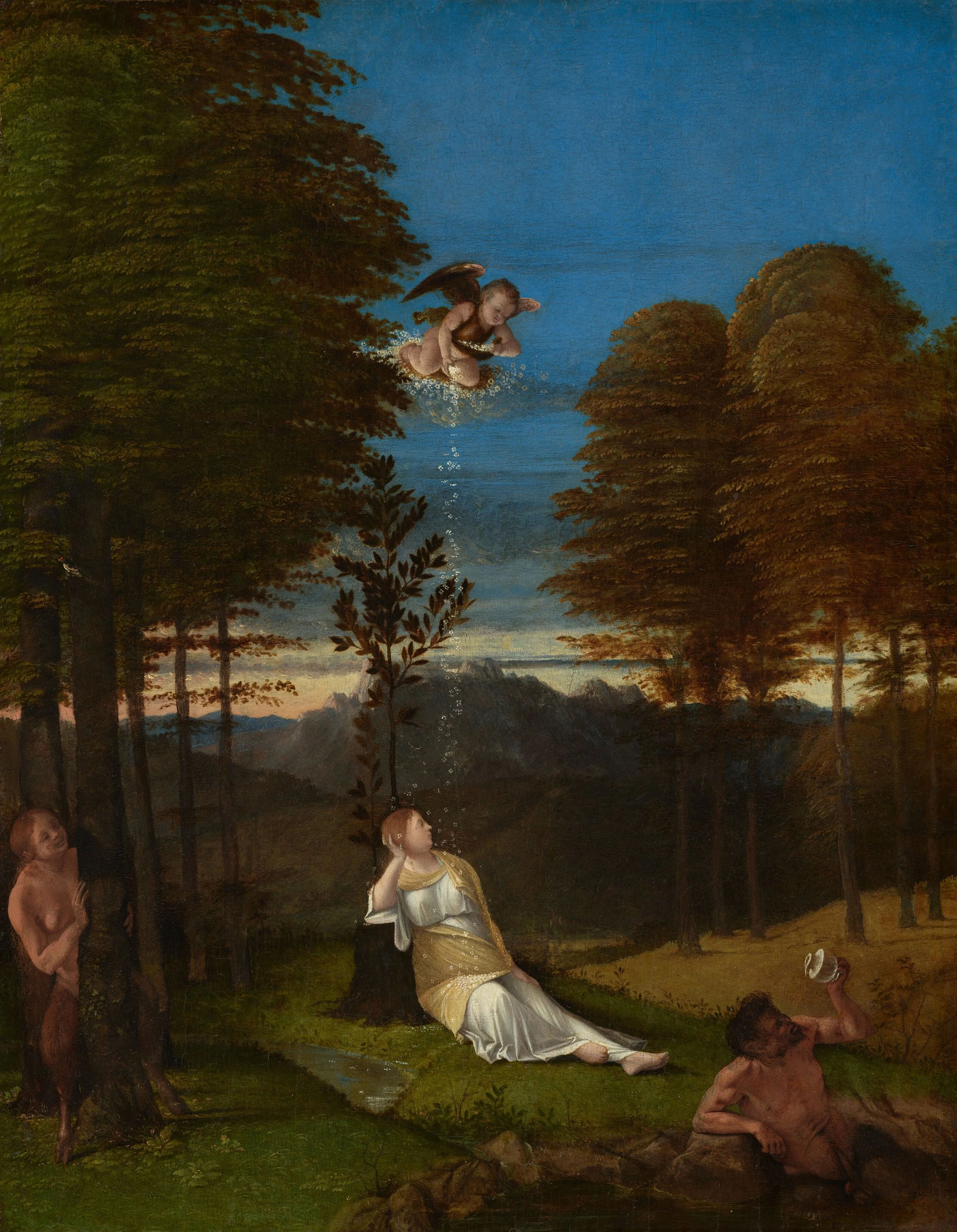
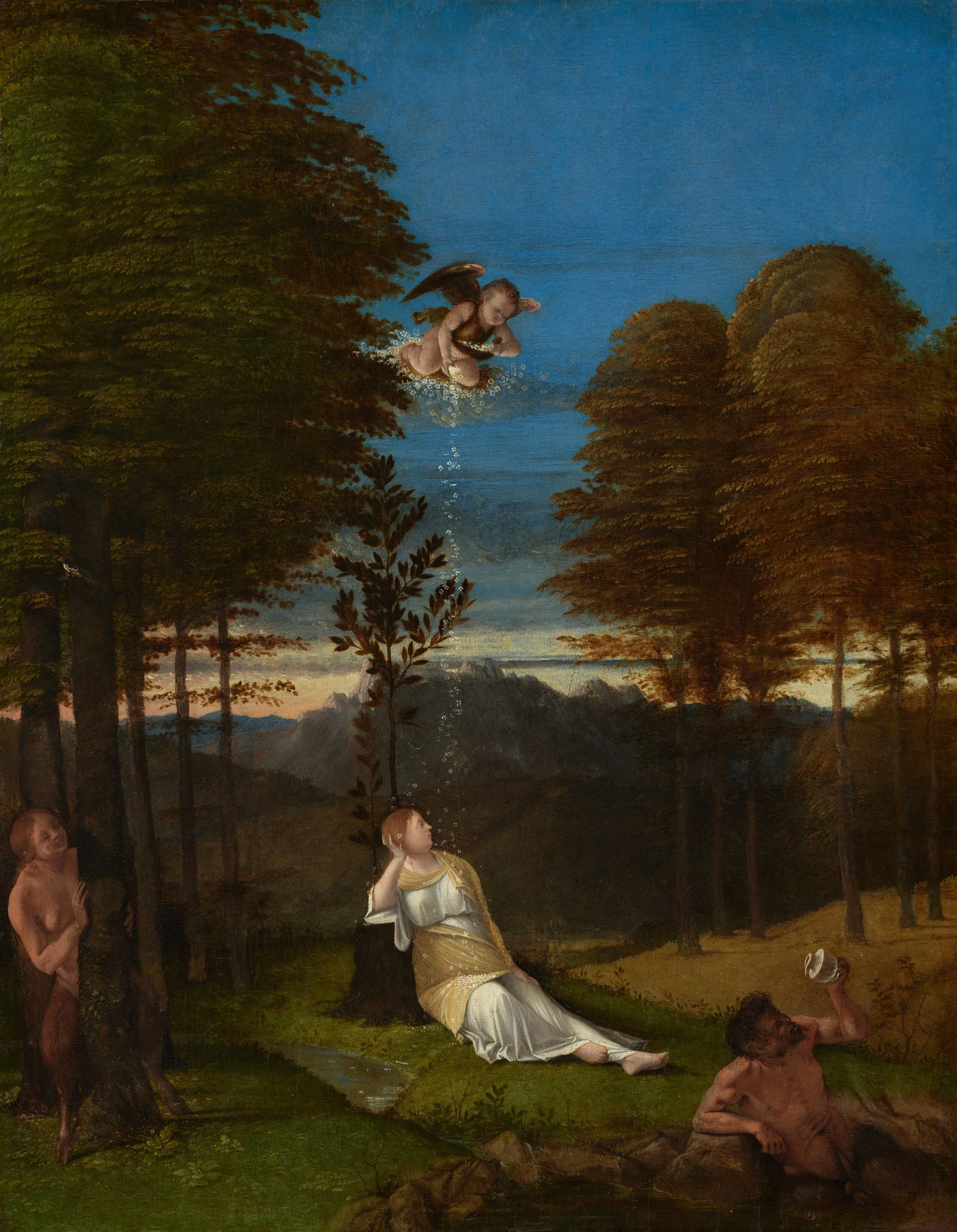
Lorenzo Lotto, Allegory of Chastity, c. 1505. Oil on panel. 42.9 × 33.7 cm (16 7/8 × 13 1/4 in.).
National Gallery of Art, Washington, D.C. (1939.1.147)
When I first sat with Lorenzo Lotto’s Allegory of Chastity, I read it alongside Michel Foucault’s remark about Paul Klee, that his images are organized by “the juxtaposition of shapes and the syntax of lines in an uncertain, reversible, floating space.”[1] Lotto’s panel behaves in much the same way. Think of linearity. Any kind of line—a taut string, a quill, a screen of reeds, a shaft of sunlight, the last standing column at Persepolis—but always linear. The lone laurel branch rising rigidly behind the reclining woman’s head, the vales of a crepuscular forest, and above all a falling cascade of flowers carefully released by the putto in a single vertical stream, are a study in one shape with infinite inflections.
The cascade is the most active element in the painting. The slew of flowers unspools downward along a single filament, refusing to drift loose. They fall in a staccato of time while the surrounding air remains still, each pulled by its own gravity. The drops of white trace a delicate scansion of Petrarch’s verse in discrete syllables before billowing down the woman’s lap and scattering below. Lotto registers the descent as sentimental abstraction, the flowers appearing as dots in a numerical sequence; yet he observes the concomitant of falling with unsparing realism. From cloud to flesh to earth, the dispersal on impact—resting on fabric, rolling into the grass, drifting onto the adjacent water, petals breaking loose and rotating from profile to full face—is followed to its smallest physical consequences. Each floret is so small, minute, and almost moot when taken singly, yet together the cascade is emblazoned on the panel as the driving event that binds the figures and landscape.
The woman anchors at the center but remains strangely passive, flaccid and voluptuous at once. She leans against the stump, yet her body does not brace; it slackens, as if she had been supine and then slightly lifted into place by Lotto’s hand of creation. Her head tilts back toward the descending flowers. The white dress and gold mantle settle in lumpy folds, but it is the floral fall that carries the weight of gravity. She looks absorbed, brooding over what is happening above her rather than reacting to the flanking satyrs or to the viewers. Who is the protagonist and who is the deuteragonist—the woman, or the putto from above?
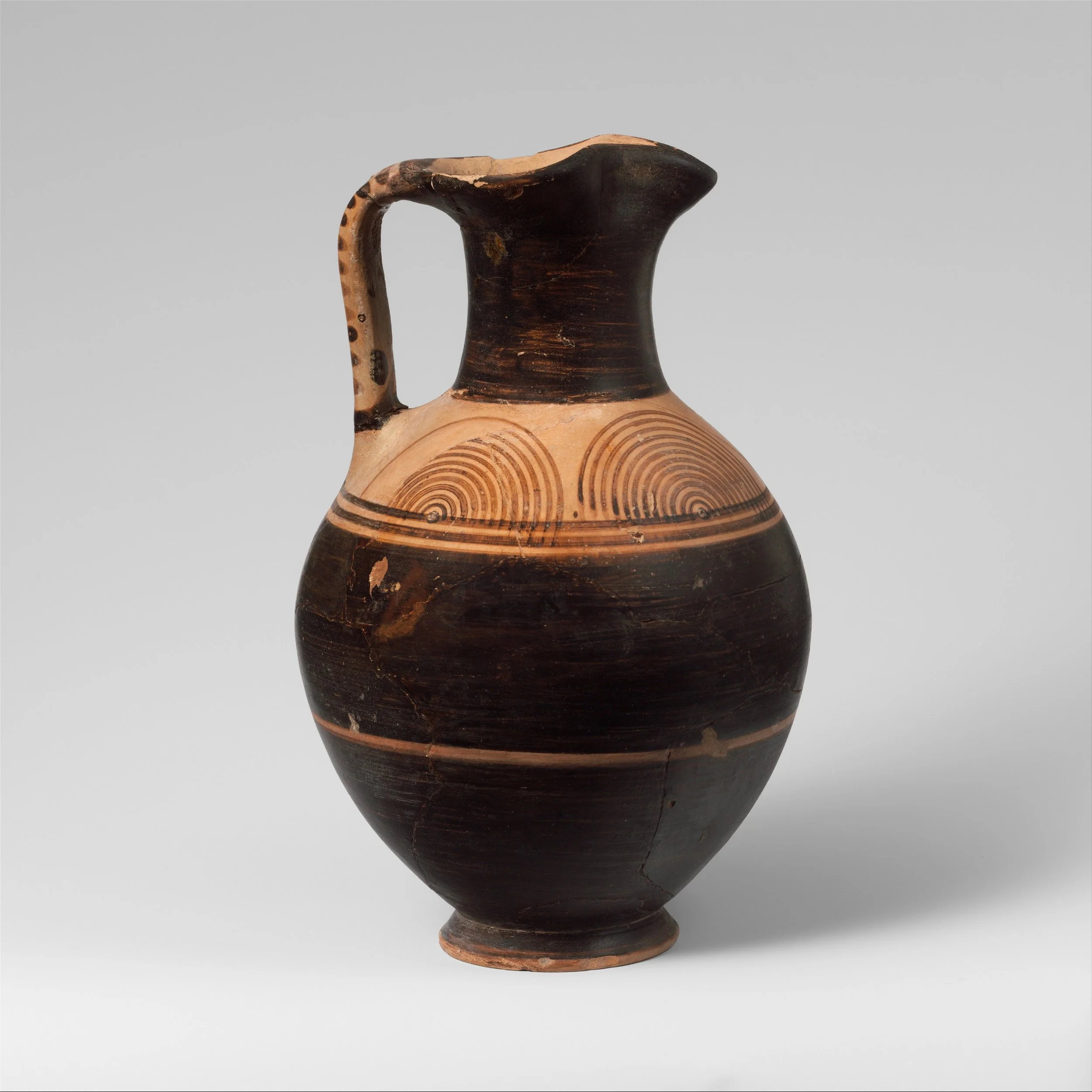
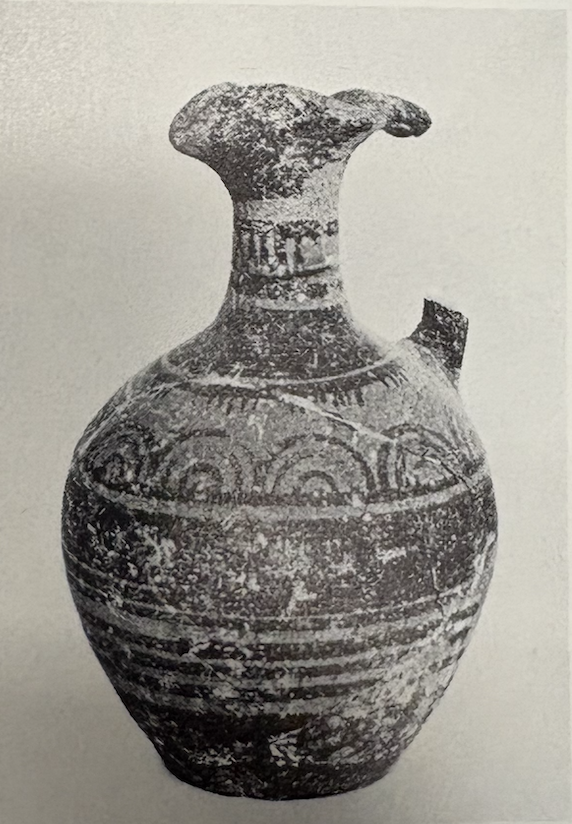
Around this action spreads a landscape that is at once enclosing and open. On the left, dense trees press close, their trunks and foliage forming a dark, sinuous wall; on the right the woods thin, opening out onto a distant glowing horizon band. Two satyrs are ensconced in the environment, half-participants, half-spectators. One peers from behind a tree at the far left, her body almost grafted onto the trunk; the other emerges from a pool or trench at the lower right, raising a wine pitcher of an unknown typology in a gesture suspended between offering and mockery (fig. 1).[2] The vessel is washed with a thin, pale sheen, so lightly laid it can be read as both glaze and liquid, leaving it unclear whether we are looking at creamy earthenware or glass holding something white. The two satyrs do not lunge or threaten; instead, they make the scene feel staged, a scene being watched within the scene. Though their positions bracket the reclining woman like parentheses, all the figures in the scene face collectively to the right, as if oriented toward an adjacent card in a divinatory spread, altering the push and pull between passivity and intrusion without resolving it.
The cadence never leaves the center, like a pendulum hung from a lofty point. Our eyes are drawn into a vertiginous whirlwind yet always return to that narrow slit. The floral descent rivets our attention but with caveats: every time we try to fix its meaning along that vertical, the surrounding forms begin to slip. The upper sky is a cool, deepening blue, suspended between day and night. In this undeciding hour, the cupid is lodged at the junction of the leaves, backed by a distant cloud. Is it perching on the tree, or hovering on flowers—or on cloud? The design is reduced to minimal, with no extra touch of form or content, almost a heraldry of an unknown arm. The uncertainty remains about whether we are witnessing a myth, a moral allegory, or a dreamscape.
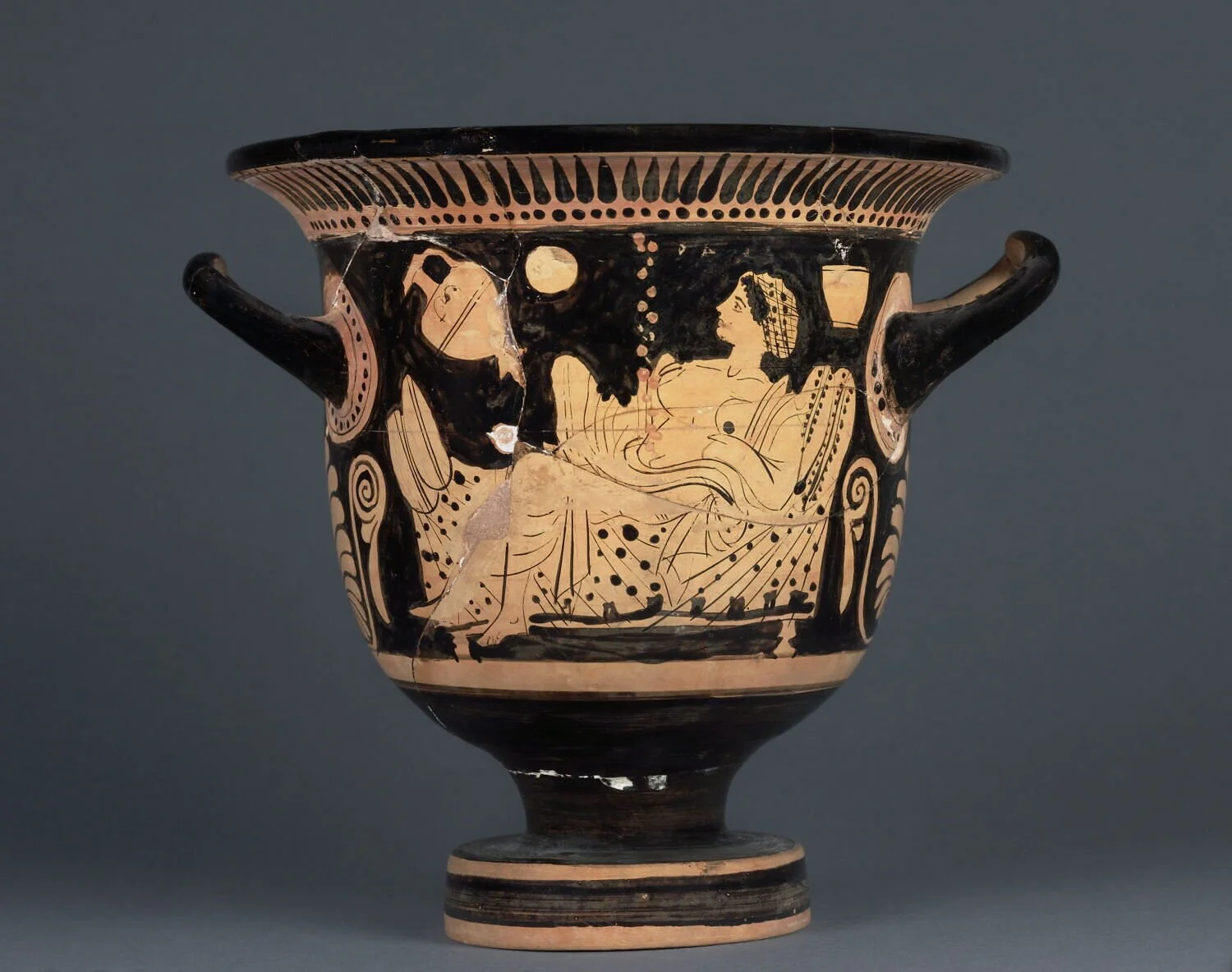
In that uncertainty, I saw it echoed in a painted Boeotian krater from the Louvre: a reclining Danaë beneath a shower of gold (fig. 2). Yet the analogy falters almost immediately. Why are these falling forms flowers rather than coins? Closer looking at the male satyr’s pitcher, executed with such prestezza, unsettles not only the vessel’s material but its typology. What appears to be a spout may instead be the liquid itself, suggesting a spoutless jug. Likewise, two open-ended brushstrokes on the opposite side may indicate either a contemporary handleless type or the remains of a broken handle, implying that it is a damaged antique. Again, the panel looks stable and narratable at first glance, but the more you follow its lines, the more the scene begins to feel reversible. Any attempt to pursue the Danaë krater analogy beyond visual resemblance quickly runs aground, since there is effectively no recoverable record of Renaissance collections of painted Greek vases reaching back to the sixteenth century, largely because such objects were poorly documented, aesthetically marginal to Renaissance classicism, and valued neither as sculpture nor as canonical antiquity—a gap that persists curiously in the historiography itself.[3] Similarly, scholarship on Lorenzo Lotto does not require every gap to be filled. Writing on the Allegory has tended to develop where discussion could be sustained while what cannot be securely developed has remained largely untouched. The resemblance with Danaë on the painted krater, however close it may appear, should be understood only as se non è vero, è ben trovato—if not true, a happy invention—and not one to be pursued further without risking a kind of scholarly “ventriloquism.”[4]
What was productively developed for the Allegory of Chastity were its iconographies and interpretations. What was left largely untouched were questions of provenance, authorship, and the work’s position within Lotto’s career, owing to the absence of documentation, inscription, period accounts of Lotto working on such a panel, or a sufficiently uninterrupted provenance. A brief review of the historiography on Lotto and the Allegory will show that these unresolved questions—however persistently prompted by close looking—are unlikely to yield results. Even so one scholarly judgement has been treated as settled: the Allegory is broadly accepted as a portrait cover, and attempts have been made to identify its lost companion. This study takes that consensus as its point of inquiry, asking why the panel has been treated as a pendant rather than as an autonomous work. Through visual analysis and comparison with surviving examples of early modern portrait coverings, I will examine why the Allegory has been understood in this way, what type of cover it may be, and try to articulate the criteria by which a work of art is recognized as cover-like.
Visually, the Allegory of Chastity is a coup de foudre for both connoisseur and lay viewers, even as its meaning and history have gone largely unexpatiated. Bereft of a sustained body of writing, the painting nonetheless appears repeatedly in highly visible contexts: as the frontispiece to the “Early Works of Lotto” chapter in the catalog of the 1997 exhibition at the National Gallery of Art in Washington, D.C.; on the covers of monographic publications such as Mauro Zanchi’s L’Opera Ermetica di Lorenzo Lotto; and as a recurring “signature” image of Lotto’s early style. Portraiture is difficult to exegete without knowledge of the sitter—a problem common in sixteenth-century Italy—and portrait covers, as this panel is widely believed to be, are even more difficult to fathom without knowledge of their paired image. Why, then, has this work attracted such attention?
What gives the work its hold on viewers is ultimately subjective, an effect produced in the encounter between Lotto and our own temperaments. Still, rarely has a work been so frequently used as a canonical image while remaining so little perused on its own terms—almost psychic, quasi-mystical. Before the Allegory of Chastity could be read, Lotto himself first had to be seen. It was precisely this visually elusive quality that Bernard Berenson first recognized when he “rediscovered” Lorenzo Lotto, noting early on the psychologically inflected character of the artist’s personality as well as the emotionally charged nature of the types he produced. As documentary material began to surface from archives in the late nineteenth century, Berenson established Lotto’s oeuvre and articulated a conception of his artistic personality.[5] Although his writings were not intended as a monograph on Lotto. Berenson used the artist to advance a new aesthetic approach grounded in psychological interpretation. He described Lotto as “a kindred spirit from another age,” already modern and “impressionistic.”[6] Across the three editions he devoted to Lotto between 1895 and 1956, Berenson increasingly shifted his focus toward how mood shapes Lotto’s art, rather than toward the details of his troubled and often unappreciated biography.[7]
A new collection of letters surfaced in 1960, including Lotto’s correspondence with Santa Maria Maggiore in Bergamo concerning the commission of the intarsias, again intimating his anxious and restless state of mind.[8] Piece by piece, Lotto came to be one of the most extensively documented artists of his time but Berenson’s psychologically oriented approach continued to shape the terms through which later scholarship understood him. Roberto Longhi later bespoke the difficulty of grasping Lotto’s elusiveness, observing that his style “is always a balance struck between a debit and a credit.”[9] In many respects a late nineteenth-century invention, Lorenzo Lotto nonetheless received sustained institutional recognition, including his first monographic exhibition, Mostra di Lorenzo Lotto (1953) at the Ducal Palace; major fifth centennial symposia at Asolo and Jesi in 1980; and the 1983 exhibition The Genius of Venice at the Royal Academy of Arts.[10] Jacques Bonnet warned of the perils involved in rediscovering Lotto, cautioning that the excitement of “all-too-convenient attributions” risked saturating the artist’s corpus with ambiguity—a concern borne out by the expansion of Lotto’s oeuvre in the exhibitions discussed above—and provoking a later scholarly “revenge of rehabilitation.”[11] Bonnet’s monograph, along with Peter Humfrey’s, written around the time of the 1997 monographic exhibition at the National Gallery of Art, marked a turn toward a more scientific and chronological approach.[12] Such methodological shifts were au courant with broader developments in art history as a discipline, which had moved beyond Victorian aestheticism—conceived as “removed from the vested interests of daily life”—toward a more sober, evidence-based practice that also understood itself as actively engaged in the political dimensions of art and the society.[13] Even so, the more recent studies continued to revolve heavily around Lotto’s life, only widening the scope with incorporations of other dimensions of studies, including ecology, psychology, economy, and geopolitics in art.[14] In this sense, despite methodological progress, scholarship on Lotto returns to Berenson’s early interest in his biography and still frames the overarching theme around his psychological uncertainty.
The early critical framework that defined Lotto as an artist also conditioned the first scholarly encounters with the Allegory of Chastity. The panel, much like Lotto himself, was a late nineteenth century rediscovery. The earliest provenance may trace to a Medici sale in 1681, after which the panel appears to have entered the antiquarian market before resurfacing in the collection of Sir Martin Conway at Allington Castle, England, by 1887.[15] In the Medici inventory, it was sold as a “panel by Giorgione…like a Danaë in a golden robe,” though Da Pozzolo has noted that it remains uncertain whether this record corresponds to the present panel.[16] The work later entered the Castelbarco Collection, although this part of the provenance depends entirely on the Milanese dealer’s claim regarding its ownership prior to Conway’s acquisition.[17]
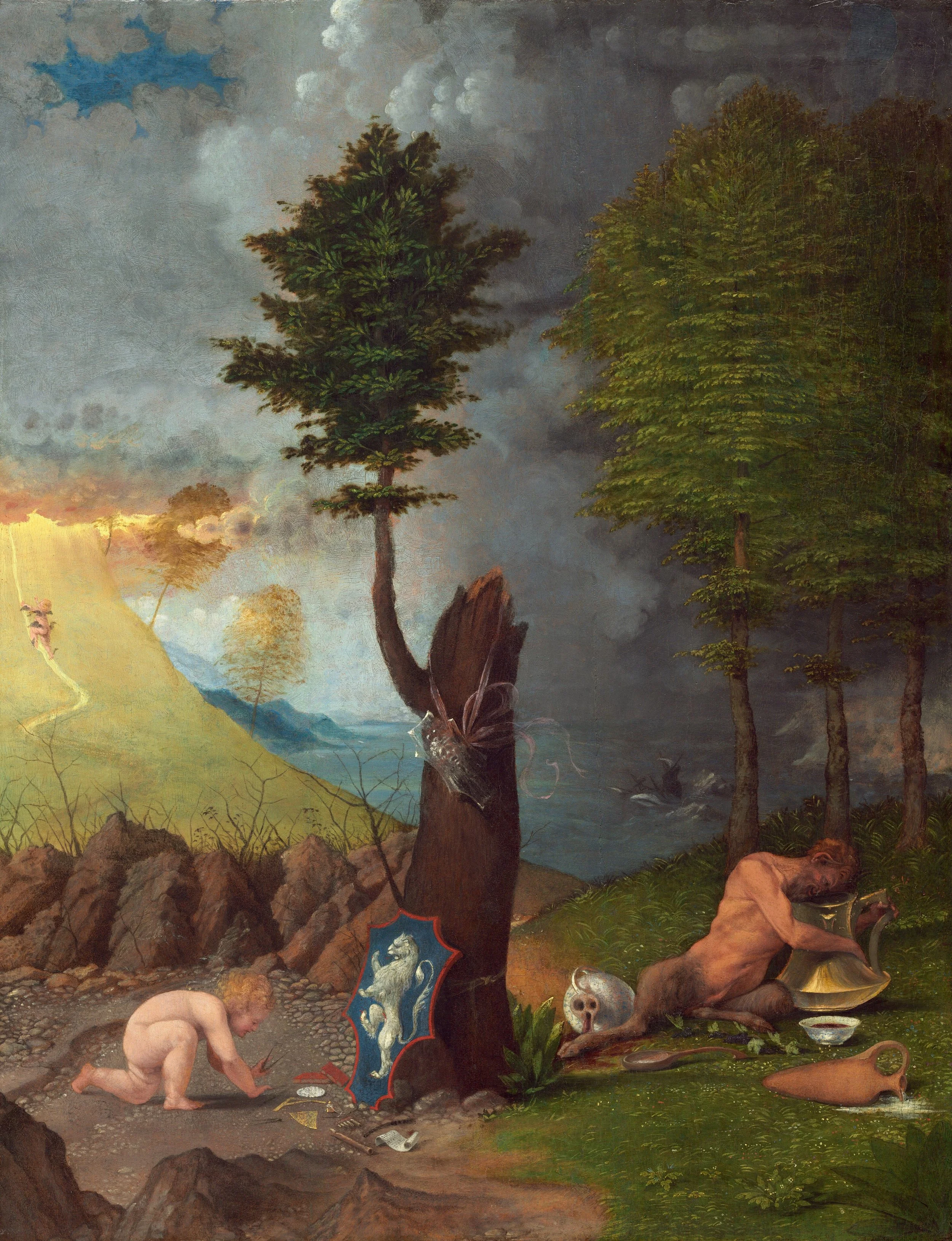
The painting was first recognized by Giovanni Morelli when it was taken to Luigi Cavenaghi for restoration in 1887, and subsequently published in 1891; Bernard Berenson immediately adopted the attribution in his first edition in 1895.[18] Prior to the panel’s discovery, Lotto was generally regarded as Bergamasque.[19] The somewhat awkward brushwork of the Allegory of Chastity suggested to scholars an earlier phase of Lotto’s career around 1500, when he was working closer to the Venetian Lagoon. However, it was not until Tancred Borenius recognized the reappearance, at a London Sotheby’s auction in 1934, of a previously lost painting described in earlier literature as another of Lotto’s portrait covers—the Allegory of Virtue and Vice, bearing a date inscription of 1505—that the current dating of the Allegory of Chastity was established (fig. 3).[20] Although often described as a “resurfacing,” the Allegory of Virtue and Vice had in fact remained traceable in its provenance history.
While the Allegory of Virtue and Vice was in private collection in London from 1891 onward, it was first identified by Gustavo Glück in 1910 as the probable cover to the portrait of Bishop Bernardo de’ Rossi in the collection of Museo di Capodimonte in Naples (fig. 4).[21] Glück noted an inscription on the reverse of the panel, which was still visible at the end of the eighteenth century but has since become illegible following the removal of the original support.[22] It remains unclear whether Glück was able to read remnants of the inscription directly or relied instead on earlier accounts by Ireneo Affò and Domenico Maria Federici; nonetheless, the attribution based on this inscription has not been seriously challenged again.
As the cover for Lotto’s Portrait of Bishop Bernardo de’ Rossi, the Allegory of Virtue and Vice is unusually explicit in the information it offers and unusually programmatic in how it frames the sitter. It is inscribed with both the date and the age of Bishop Rossi—1 July 1505, and 36 years, 10 months, 5 days. At the center stands a tree growing from a broken black stump, its trunk splitting into two moralized halves: on the left the foliage is green and flourishing, while on the right the branches are bare and dead. At the base of the stump appears de’ Rossi’s coat of arms, binding the allegory directly to the sitter’s identity.[23] Beneath the green side, a small nude child crawls forward beside scattered books and emblems of the liberal arts, while beneath the dead branches a drunken Silenus sprawl among wine vessels and musical instruments. The background extends the consequences foreshadowed in the foreground: on the left a second, many-winged putto rises toward spiritual enlightenment; on the right the land drops toward a dark ocean where a small boat struggles in rough water, the trees thicken, and the sky turns stormy.
The symbolic message in the cover, confirmed by the extensive knowledge of Bishop Bernardo de' Rossi’s life, encourages much ink being spilled on the iconographical interpretation and on the search of potential sitter that is associated with the Allegory of Chastity. While Berenson’s interpretation of Rossi’s cover as “a clear moral warning on the goods and evils deriving from virtues and vices” has been retained, his interpretation in the other Allegory has not.[24] In the 1997 catalog, Brown rejected Berenson’s identification of the figure as Danaë, as well as Shapley’s proposal of the nymph Rhodos in 1979, citing the presence of flowers rather than gold.[25] It is worth noting, however, that Berenson did not advance Danaë as an interpretation of his own. He merely recorded that the panel was in the Conway collection “where it was called Danaë,” a designation already present in the earliest Medici sale record of 1681.[26] As a further complication in modern scholarship, the current title used by the National Gallery, the Allegory of Chastity, derives from Francesca Cortesi Bosco’s interpretation of the painting as a “picture of the rational soul,” identified with a work Lotto was recorded as having brought with him to the Marche but failed to sell in 1550.[27] On this reading, the panel is a personal memoir rather than a commission comparable to Rossi’s. However, the interpretation of generally accepted in scholarship is that the image functions as an ekphrasis inspired by Petrarch’s Laura in Il Canzoniere, who is depicted leaning against a laurel tree beside a stream and receives a shower of flowers.[28]
A title at odds with its prevailing interpretation? This is hardly the first instance of diachronic misalignment in art historical research.[29] If we return to Berenson’s first edition in 1895, written nearly four decades before the London “rediscovery” of the Rossi Allegory, the Allegory of Chastity was not even conceived as a portrait cover. Berenson solely emphasized the German and Lombard influences on Lotto’s cool, grayish palette, as well as the pseudo-Gothic modeling of his figures derived from the altarpieces by the school of Alvise Vivarini.[30]
If the Allegory of Virtue and Vice, the second earliest dated work in Lotto’s oeuvre, offers the first evidence of Lotto’s “lifelong penchant for the symbolic,” in a way it also reshapes scholarly readings of what a cover could be.[31] To understand why the Allegory of Chastity has been treated as a portrait cover at all, we need to shift attention toward the logic of the cover itself—how they were made, used, and seen.
Portrait covers are rare today not because they were marginal, but because they were worked, as inventories from across Europe attest to their widespread use.[32] Over time, changes to original frames led to the scattering of covers, while alteration of the original panels often eradicated reverse images.[33] Whereas portraits today are considered accessible and public-facing, in early modern Europe they were highly restricted and carefully mediated, giving rise to a period of flourishing development and invention in covers and reverses between the fifteenth and sixteenth centuries.[34]
These took on several structural permutations: some acquired a reverse, a covered lid, or hinged panels, each serving a different function.[35] Veiling, by means of a curtain placed before an image, glorified and mystified the act of unveiling with sanctity. For portraits with reverses, earlier examples in the fourteenth century took the form of fictive stone or heraldic devices.[36] Over time, these developed into more complex programs of imprese and allegorical scenes, often adorned with botanical studies or vanitas motifs, a shift that, as Nogueira has suggested, marks a fundamental break from heraldry in that these reverses are no longer designed to be primarily informative or readily legible.[37] This development also extended to hinged or sliding covers, which became widespread from the second half of the fifteenth century onward.[38] Before that, extending back to Roman times, hinged shutters in the form of diptychs or triptychs, or paintings placed on the inside of lids or cassoni, served to conceal identities, to mark a likeness as private property rather than a public display, to enforce a kind of decorum by keeping a face from being readily available, or, conversely, to arouse desire and curiosity by withholding.[39]
Whether painted on the reverse or added as an auxiliary part, portraits with allegorical programs, like Bernardo de’ Rossi’s, convey statements through literary means.[40] Inspired by medallic models—flexible in their double sides and incorporation of text—such portraits are numismatic in conception. Identity is displaced away from the face and into signs: coat of arms, motto, mask, emblem, allegory… These elements supply an alternative mode of recognition, a coded identity that precedes the revealed likeness.
Taking the Rossi Allegory as comparanda, the Allegory of Chastity exhibits a similar emblematic logic in several respects that give it a cover-like character. First, much of the scene is deliberately flattened and regularized. Although the image is narrative—in Nogueira’s sense, already a complication from direct heraldry—there is no natural accident in the scene: every line and form is precisely placed, as seen in the exact alignment of the putto, the cloud, and the tree. Such legibility reflects a numismatic mode of arrangement rather than a pictorial one. On the reverse of a late Imperial aureus of Diocletian, the inscription “IOVI CONSERVAT” is carefully articulated around the thunderbolt and staff held by the nude Jupiter (fig. 5).[41] Here the text gives way to the device. On Francesco da Sangallo’s Portrait Medal of Paolo Giovio, the bishop is cast with faithful likeness and naturalism: the fur coat projects outward and the hat intrudes beyond the field into the legend, yet its tip carefully stops short of encroaching upon the inscribed “S” (fig. 6).[42] Here the imagery gives way to the text. I read this legibility as a vestigial trait carried over from the transition between stand-alone heraldry and compounded allegorical emblem. The Portrait Cover with a Wild Man by Jakob Elsner or his workshop, made in 1497, illustrates such transitional style: the two coats of arms still assert prominence, as in earlier heraldic reverses, yet they begin to recede before a larger pictorial field—a forest animated by birds—and cease to be static, as the shields are held off-kilter by the man (fig. 7). Likewise in the Rossi Allegory, the coat-of-arm is further reduced in scale; every mathematical instrument and vessel is isolated and fully legible, arranged without hierarchy or overlap. Although, to my eye, Lotto’s attention to trompe-l’œil—particularly in the three-dimensionality of the cartellino and the materiality of the satyr’s receptacles—raises the possibility that the Allegory of Virtue and Vice represents a more mature stage in his career, postdate the other Allegory.[43]
A second medallic character carried into painted emblems is symmetry. The axial and vertical organization evident in both Allegories—the cascade of flowers and the tree stump bearing Rossi’s coat of arms—derives directly from earlier numismatic and heraldic conventions. In a late fifteenth-century Allegorical Landscape, painted on the reverse of a portrait, a potted tree stands alone against a lagoon landscape, isolated and frontal (fig. 8). Set beside Hans Memling’s Laurel Stem with Banderole, this transition feels like a sudden clearing of vision (fig. 9). What had once existed as silhouette breaks free, and we turn from the cave wall to sight, seeing signs become forms that carry weight and occupy space. Style evolved but symmetry was retained in the process.
In the Allegory, the landscape, too, is structured geometrically. Three trees are grouped in a stable triangular formation, one rising behind two in front, mirrored on both sides. On the far left a third cluster of three is added, two behind and one in front, forming a crenellated rhythm across the background. The landscape functions like the reverse of a coin—the side reserved for locality or symbolic order. By contrast, the two satyrs are portrayed with specificity and tactility. Their musculature, bone structure, and gestures are like the obverse, the bust side. Together the panel is like a coin “unwrapped.”
A third quality shared by the two Allegories emerges not from medallic precedent but from the logic of painted covers and the ways they distinguish themselves from the portraits they serve. In the Allegory of Chastity, the reclining woman, though anatomically intelligible, is handled with a studied indifference. In the Allegory of Virtue and Vice, this disparity of effort is also evident in the contrast between the flatness of the profile-bound figures on the cover and the articulated likeness of Bernardo de’ Rossi; the rigid, linear spill of white liquid that refuses to percolate into the ground and the tenderness of the green curtain behind the sitter. A more direct comparison, without suggesting any historical link, can be seen in the different emphases on shading versus contour in Hans Memling’s Portrait of Bernardo Bembo and Giovanni Bellini’s portrait cover, A Portrait of a Young Boy, painted for a wooden cabinet that once held the marble bust of the boy’s father (Fig. 10, 11).[44]
Maybe we could say that portrait covers deliberately forgo any degree of painterly “sfumato”—which, as Alexander Nagel has observed, effects a gradual passage from known to unknown, thereby secularizes and aestheticizes mystery—in favor of a studied certainty.[45] Lotto’s handling of a single color, pink, offers a clear comparison. Within his oeuvre, rose petals recur as a motif, yet their treatment varies widely and does not follow a chronological trajectory of increasing artistic maturity. In Venus and Cupid, dated to the 1520s, the petals scattered across her naked skin are rendered with close naturalism, their hues restrained to a narrow range from pale rose to white (fig. 12). By contrast, in the Portrait of a Young Man in the Accademia, generally dated to the end of the 1520s, around the time he completed the Odoni Portrait in 1527, the rose is saturated to a dense carmine, sharply set against the green tablecloth (fig. 13). In the Portrait of a Man in the Borghese, from 1530s, and in the Madonna of the Rosary in Cingoli, commissioned in 1539, the fresco-like palette is again subdued, restrained by muted, almost withering melancholy. (fig. 14, 15). Set against these examples, can we not only see the impressionistic cascade in the Allegory of Chastity as a mark of young Lotto’s incipient artistic career, but also as a deliberate stylistic bathos tailored to the concinnitas of portrait covers?
If the Allegory of Chastity was indeed a portrait cover, we should also consider what type it might have been. In the case of Rossi’s Allegory, although it is unknown when the portrait was separated from its allegorical panel, most scholars have proposed a sliding format, based on the wide unpainted margins at the top and bottom.[46] For the Allegory of Chastity, the Portrait of a Woman in Dijon is generally proposed as a corollary because the woman’s facial features closely resemble the reclining figure. Another proposal, advanced by Giorgio Mascherpa, identified the Allegory (42.9 × 33.7 cm) as a cover for the Vienna Youth with a Lantern (42.8 × 35.3cm), but Brown rejects this pairing on the basis of their size difference (fig. 16).[47] Yet such differences should not be decisive. In Jacometto’s Nun of San Secondo (10.2 × 7.3 cm), the reverse landscape functions as a lid for a slightly larger portrait, Alvise Contarini (11.75 × 8.57 cm) (fig. 17). As a result, the two portraits face each other when closed. Rather than assuming a single “cover” format for the Allegory, we should therefore consider multiple structural possibilities and avoid dismissing possible candidates on the basis of slight size differences.
Of course, access to images or conservation reports of the reverse or edges of the panel would greatly clarify these questions. In their absence, and without making speculative identifications of its sitters, I hope that it is still possible to consider the structural relation between the Allegory and its portrait through visual analysis. The form and material of a cover—sliding or hinged, wood, glass or fabric timpani—determine not only how the image is handled but how quickly the likeness is accessed: whether the reveal is sudden or gradual, frontal or lateral. The Allegory of Chastity was made to read quickly. Unlike Rossi’s Allegory, which presents an array of trappings tied to the sitter, the only discernible accoutrement here is the handleless oenochoe held by the male satyr. And even this is partially obscured by its loose brushstrokes. The economy extends further: all figures—the woman, the satyrs, and the putto—are oriented in the same dextral direction. This is true, to a degree, of Rossi’s cover as well, though there the ascending putto and the broken shipwreck in the background complicate the directional pull. If Rossi’s Allegory functioned as a sliding cover, as its unpainted margins suggest, the Allegory of Chastity may have operated similarly, its left-to-right movement anticipating the lateral unveiling of the sitter while directing the allegorical figures toward the subsequent narrative of an allegory, or a concluding coda. The act of opening becomes interpretive: the viewer is asked to pass from sign to person, from type to individual, and from story to biography. At rest, however, the cover demands a different mode of engagement—a slower reading—one that recalls Settis’ suggestion of Giorgione’s “hidden subjects,” purposely efface key signifiers so the work can function as an entertainment to the “Renaissance men” to interpretate and discourse.[48] Schmitter likewise emphasizes that imprese, the ancillary portrait adjacency like the Allegories, accrues meaning through duration, return, and sustained contemplation rather than immediate resolution, often shaped in dialogue with the patron. Alternatively, Lippincott, together with Wittkower’s period-eye view on enigmatic imagery in the Renaissance, stresses that such programs were not originally obscure: their meanings were intelligible to contemporary viewers and have become opaque to us only through the loss of shared cultural knowledge and personal associations with the sitter.[49] Whether read quickly in motion or slowly at rest, the Allegory structures its meaning through use rather than viewing alone.
To articulate the duplicity between portraits and their covers is to recognize that covers are required to operate differently from the likenesses they conceal. They often do so through a purposeful meagerness: a reduction of depth, pared-down forms, and an almost art brut arrangement of elements. In Lotto’s Allegory of Chastity, as in many sixteenth-century narrative covers, this produces an oxymoron built into the object itself: an esoteric subject painted with exoteric hands. A simple image, refined in their shabbiness, amiable in their restraint, the Allegory of Chastity is not a puzzle; it functioned first, and is still meant, to be looked at.
Plates
Figure 1: (Left) Attic, Terracotta oinochoe, late 10th to early 9th century BCE.
Metropolitan Museum of Art (30.118.1)
(Right) Rodes 14090, example of an oinochoe with broken handle.
John Nicolas Coldstream, Methuen’s Handbooks of Archaeology: Greek Geometric Pottery (Methuen, 1968), Plate 59 e.
Figure 2: Boeotia Crater, c. 430 BCE.
Louvre, CA 925
Figure 3: Lorenzo Lotto, The Allegory of Virtue and Vice, 1505. Oil on panel.
National Gallery of Art (1939.1.156)
Notes
[1] Michel Foucault, This Is Not a Pipe, trans. James Harkness (University of California Press, 1983), 33.
[2] John Nicolas Coldstream, Methuen’s Handbooks of Archaeology: Greek Geometric Pottery (Methuen, 1968), Pl. 59. The oenochoe provides the closest typological parallel, although almost all examples retain a neck handle. The anomalous form depicted in Lotto’s Allegory therefore suggests either a sixteenth-century variation—unlikely given the impracticality of a handleless pitcher, which also explains the satyr’s awkward manner of holding it—or an ancient vessel whose handle has broken off, as illustrated by the example on the cited plate.
[3] Lauren Murphy, “Valuing Vases: Ancient Greek and South Italian Pottery in Early Modern European Collections” (PhD diss., La Trobe University, 2025). Murphy’s dissertation is one of the few studies to address directly the problem of a gap in the early modern encounters with painted Greek pottery, stressing the sparsity, imprecision, and chronological instability of the documentary record prior to the eighteenth century. This difficulty was already noted by Fern Rusk Shapley in 1919, who expressed genuine confusion over the omission of vase painting from Renaissance art-historical discourse despite its abundance. He concluded that identifying specific vases in Renaissance contexts was a “challenging and perhaps impossible task.” One explanation, proposed by Robert Manuel Cook, is the “repugnance of style”: the flattened figures, schematic anatomy, and non-naturalistic conventions of vase painting ran counter to Renaissance ideals of classicism and naturalism. Murphy notes that scholarship on Renaissance collecting of antique vases is limited to the following: R. M. Cook 1997, Greek Painted Pottery, Routledge, London; B. A. Sparkes 1996, The Red and the Black, Routledge, London, V. Nørskov 2002, Greek Vases in New Contexts, Aarhus University Press, Aarhus; R. Higginson 2016, A History of the Study of South Italian Black- and Red-Figure Pottery, BAR Publishing, Oxford.
[4] Michael Squire, “Introductory Reflections: Making Sense of Ancient Sight,” in Sight and the Ancient Senses, ed. Michael Squire (Routledge, 2016), 1. Squire identifies a problem of “ventriloquism” in classical vase studies, whereby scholars supply objects with a first-person voice, allowing them to tell a particular interpretive story on the basis of limited or selective evidence.
[5] Peter Humfrey, Lorenzo Lotto (Yale University Press, 1997), 176-182. See Humfrey for a compilation of Lotto’s documents. Lotto’s will of 1546 was discovered in the Venetian city archives in 1887, and his account book, Libro di Spese Diverse, kept over the final eighteen years of his life, was found in the archives at Loreto in 1892.
[6] Bernard Berenson, Lorenzo Lotto (The Phaidon, 1956), 160.
[7] Enrico Maria Dal Pozzolo, Lorenzo Lotto: Catalogo Generale dei Dipinti (Skira: 2021), 66-93. See Dal Pozzolo for a detailed chronology of Lotto’s life. In 1554, at the age around 74, Lotto joined the religious community of the Basilica of the Santa Casa at Loreto as a lay brother to find his inner piece from gossips and livelihood hardships.
[8] In 1513 Lotto left central Italy and resided again in Bergamo, the Venetian Lombardy. He worked on a cyclical commission, a series of intarsias of Old Testament stories for the choir stall at Santa Maria Maggiore in Bergamo in 1524, and continued long distance when he left for Venice. The correspondences found in the 1960s were with his employer, a theologian employed by the Consorzio della Misericordia. Lotto made changes to the scheme and add a scene of Lot as a reference to his own name.
[9] Roberto Longhi, “Lorenzo Lotto accanto a Raffaelo a Roma,” Notizie da Palazzo Albani (1980): 105-132.
[10] The first major monographic exhibition in 1953 catalyzed an initial wave of monographic scholarship. See Anna Banti, Lorenzo Lotto (Florence, 1953); Luigi Coletti, Lotto (Bergamo, 1953); Terisio Pignatti, Lorenzo Lotto (Milan, 1953); and Berenson’s final edition in 1956.
[11] Jacques Bonnet, Lorenzo Lotto (Adam Biro, 1996), 8.
[12] David Alan Brown, “The Early Works,” in Lorenzo Lotto: Rediscovered Master of the Renaissance, eds. David Alan Brown, Peter Humfrey, and Mauro Lucco (National Gallery of Art; Yale University Press, 1997), 85-87. X-radiography led by David Bull and Ulrich Birkmaier shows that underneath the putto is a painted-over seated figure upside down, and further infrared examination shows that the figure was nude with its legs open. The posture closely aligns with Lotto’s Budapest Apollo and another similar panel in the National Gallery collection depicting Hercules at the Crossroads, which could be the initial subject Lotto conceived. Lotto likely rotated the panel 180 degrees to refit the theme. The yellow drapery on the reclining woman is decorated with gold leaf.
[13] Rachel Teukolsky, “The Politics of Formalist Art Criticism: Pater’s ‘School of Giorgione,’” in Walter Pater: Transparencies of Desire, ed. Laurel Brake, Lesley Higgins, and Carolyn Williams (ELT Press, 2002), 151-52.
[14] Stephen J. Campbell, The Endless Periphery: Toward a Geopolitics of Art in Lorenzo Lotto’s Italy (The University of Chicago Press, 1997). See Campbell for a methodological reorientation toward cultural geography and pluralism on the Apennine peninsula, articulated through Lotto’s mobility.
[15] Jaynie Anderson, Giorgione: Peintre de la “Brièveté Poétique” (Éditions de la Lagune, 1996), 79. See Anderson for its Medici sale in 1681 as a Giorgione.
[16] Dal Pozzolo, Lorenzo Lotto, 114.
[17] For its sale from the Castelbarco collection to the Conway collection, see Martin Conway, The Sport of Collecting (Frederick A. Stokes Company, 1914), 38-44. The painting then was acquired by the Samuel H. Kress Foundation and donated to the National Gallery of Art in 1939.
[18] Giovanni Morelli, Kunstkritische Studien über italienische Malerei (F. A. Brockhaus, 1893), 59.
[19] Brown, Rediscovered Master, 11.
[20] Tancred Borenius, “The New Lotto,” The Burlington Magazine 65, no. 380 (1934): 228. The Allegory of Virtue and Vice was sold by Sotheby’s on 9 May, 1934, no. 129. Purchased by Martin Asscher.
[21] Gustavo Glück, Ein neugefundenes Jugendwerk Lorenzo Lottos, in Aus Drei Jahrhunderten europäischer Malerei (Vienna, 1933), 272-274. Glück recorded the inscription on the verso: BERNARDVS. RVBEVS. / BERCETI. CO-MES. PONTIF. TARVIS. / AETAT. ANN. XXXVI. MENSE. X. D.V. / LAURENTIVS LOTTVS. P. CAL. / IVL. M.D.V.
[22] Ireneo Affò, Memorie degli scrittori e letterati parmigiani, III (Ducale Tipografia, 1791), 200-201; Domenico Maria Federici, Memorie trevigiane sulle opere di disegno (Francesco Andreola, 1803), II, 5-6.
[23] Dal Pozzolo, Lorenzo Lotto, 107. Bernardo de’ Rossi was a nobleman from the Parma region who rose through Venetian patronage—archdeacon of Padua with an abbey in Zadar, bishop of Belluno in 1487, and then bishop of Treviso in 1499, where he maintained a small court that included Lotto. As an outsider from Parma, a political conflict with the Venetian Podestà of Treviso and the Onigo family culminated in a failed plot against him. The commissioning of the Allegory of Virtue and Vice is understood as a response to this episode.
[24] Berenson, Lotto (1956), 16-17.
[25] Bernard Berenson, Lorenzo Lotto: An Essay in Constructive Art Criticism (G.P. Putnam's Sons, 1895), 19; Fern Rusk Shapley, Catalogue of the Italian Paintings, vol. I (National Gallery of Art, 1979), 275-277.
[26] Berenson, Lotto (1956), 4.
[27] Francesca Cortesi Bosco, “‘Autographi inedita di Lotto’ il primo testament (1531) e un codicillo (1533),” Bergomum XCIII (1998): 38-40.
[28] Francesco Petrarch, Il Canzoniere, or Rerum vulgarium fragmenta (Indiana University Press, 1999), lyric CXXVI (Chiare, fresche et dolci acque). The relevant lyrics are: Clear fresh and sweet waters, where she, the only one who seemed woman to me, rested her beautiful limbs) / A rain of flowers descended (sweet in the memory) from the beautiful branches into her lap, and she sat there humble amongst such glory, covered now by the loving shower. A flower fell on her hem, one in her braided blonde hair, that was seen on that day to be like chased gold and pearl: one rested on the ground, and one in the water.
[29] Charles Hope, Giorgione or Titian? A History of a Controversy (The Frick Collection, 2003), 18. An example of this lag in art historical scholarship is the case of Giorgione: although Jacopo Morelli discovered Marcantonio Michiel’s notes in the Biblioteca Marciana in 1800, mentioning The Tempest, they attracted little attention until 1871, when Crowe and Cavalcaselle first cited Michiel’s note in A History of Painting in North Italy.
[30] Humfrey, Lotto, 179-82. Humfrey returned to Berenson’s northern influence. He emphasizes Dürer’s impact on both of Lotto’s Allegories. The Northern artist’s prints circulated in Treviso, and Lotto could have been aware of Dürer’s arrival in Venice in the autumn of 1505. Dürer’s 1501 Nude drawing (Albertina, Vienna) closely resembles the reclining figure, and the widely received Hypnerotomachia Poliphili includes a woodcut plate of a Nymph at a Fountain with a comparable pose; its author, Francesco Colonna, also spent years in Treviso.
[31] Bonnet, Lotto, 20.
[32] Lorne Campbell, Renaissance Portraits: European Portrait-Painting in the 14th, 15th and 16th Centuries (Yale University Press, 1990), 65-67. Campbell notes the inventory from Margaret of Austria in Mechelen has a category specifically for “paintings that lacked covers” (sans converte).
[33] Angelica Dülberg, Privatporträts: Geschichte und Ikonologie einer Gattung im 15. und 16. Jahrhundert (Gebrüder Mann Verlag, 1990), 18-24.
[34] Victor Schmidt, “Curtains, Revelatio, and Pictorial Reality in Late Medieval and Renaissance Italy,” in Weaving, Veiling, and Dressing: Textiles and Their Metaphors in the Late Middle Ages, ed. Kathryn M. Rudy and Barbara Baert (Brepols, 2007), 212-13.
[35] Alison Manges Nogueira, “Uncovering Renaissance Portraits,” in Hidden Faces: Covered Portraits of the Renaissance, ed. Alison Manges Nogueira (The Metropolitan Museum of Art, 2024), 16. For a comprehensive study of portrait covers and reverses, see the exhibition catalogue.
[36] Victor Schmidt, Painted Piety: Panel Paintings for Personal Devotion in Tuscany, 1250-1400 (Centro Di, 2005), 44. Schmidt stated that “almost every small panel originally had a worked verso… such decoration is also found in the earliest private portraits.”
[37] Nogueira, “Uncovering Renaissance Portraits,” 30.
[38] Campbell, “Renaissance Portraits,” 65-67.
[39] Schmidt, “Curtains, Revelatio, and Pictorial Reality,” 193.
[40] John Pope-Hennessy, The Portrait in the Renaissance (Bollingen Foundation, 1966), 205.
[41] Nogueira, “Coining Multisided Portraits: Precedents and Parallels,” in Hidden Faces: Covered Portraits of the Renaissance, ed. Alison Manges Nogueira (The Metropolitan Museum of Art, 2024), 46.
[42] Nogueira, “Coining Multisided Portraits,” 54. Nogueira noted that Giovio was portrayed with his well-known physiognomy: “craggy, gaunt face, visibly sunken cheeks, and a mole on the side of his long nose.”
[43] The Allegory of Virtue and Vice was painted in 1505. The Allegory of Chastity was dated to circa 1500 on stylistic grounds prior to 1934, but was later redated to 1505 by association. I believe the earlier dating to be more convincing.
[44] Peter Humfrey, “The Portrait in Fifteen-Century Venice,” in The Renaissance Portrait: From Donatello to Bellini, exh. cat., eds. Keith Christiansen and Stefan Wepplemann (The Metropolitan Museum of Art, 2011), 57.
[45] Alexander Nagel, “Icons and Early Modern Portraits,” in El Retrato del Renacimiento, exh. cat., ed. Miguel Falomir (Museo Nacional del Prado, 2008), 424. Nagel defined Leonardo’s sfumato as a technique that offers “an infinitely gradual path from the known to the unknown.” For a fuller analysis of this process, see Nagel, “Leonardo and Sfumato.” RES: Anthropology and Aesthetics, 24 (1993), 7-15.
[46] Dülberg, Privatporträts, 190. The sliding format is also supported by Brown (1997) and Dal Pozzolo (2021).
[47] Giorgio Mascherpa, Invito a Lorenzo Lotto (Rusconi, 1980), 15, 22-23.
[48] Salvatore Settis, La ‘Tempesta’ interpretata: Giorgione, i commitenti, il soggetto (Enaudi, 1978), 118-9.
[49] Kristen Lippincott, “The Genesis and Significance of the Fifteenth-Century Italian Impresa,” in Chivalry in the Renaissance, cd. Sydney Anglo (The Boydell Press, 1990), 71, 76; Rudolf Wittkower, “Giorgione and Arcady,” in Idea and Image: Studies in the Italian Renaissance (Thames & Hudson, 1978), 171.