2025, Amherst
Maddalena Strozzi Doni’s Frizzy Hair
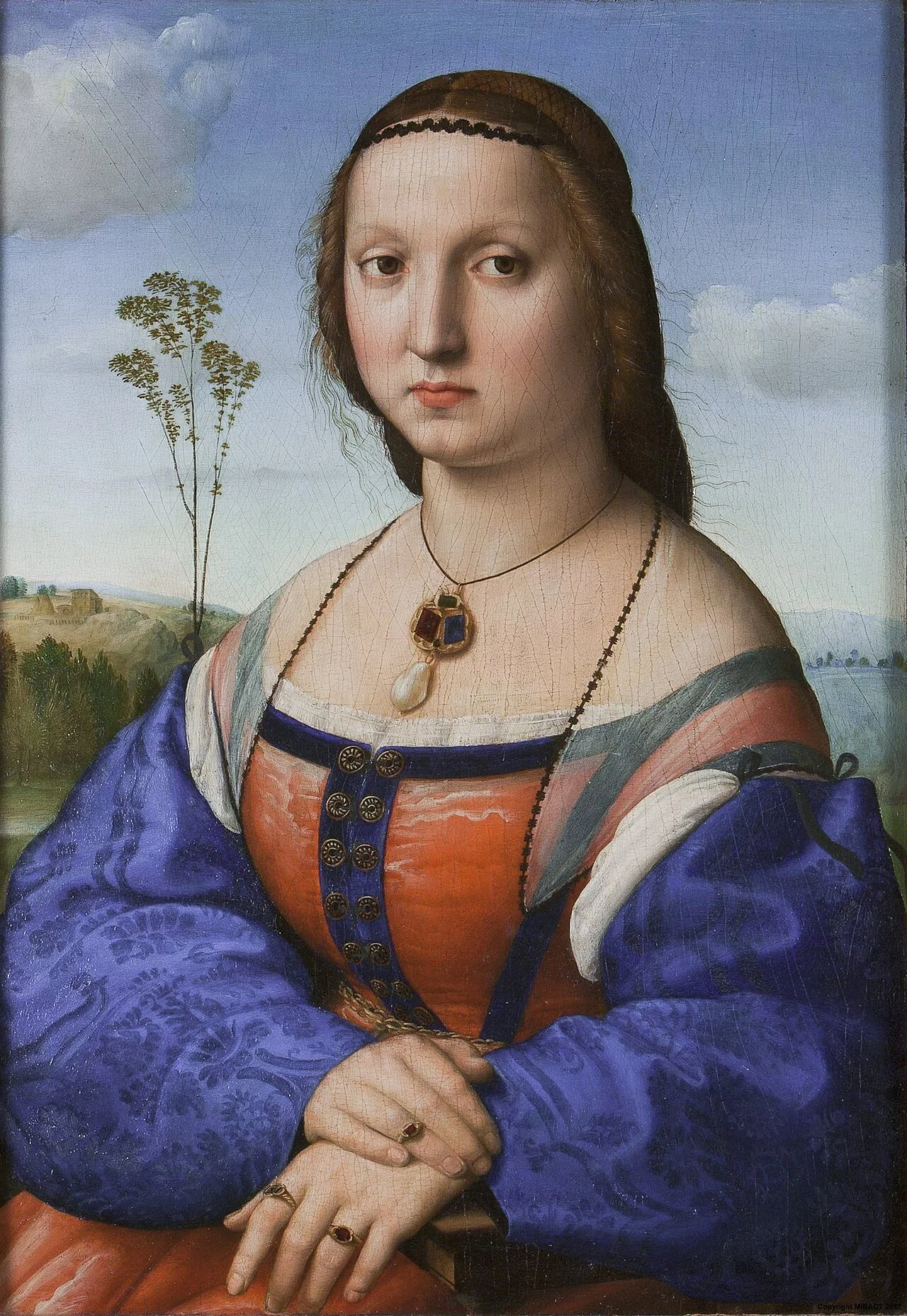
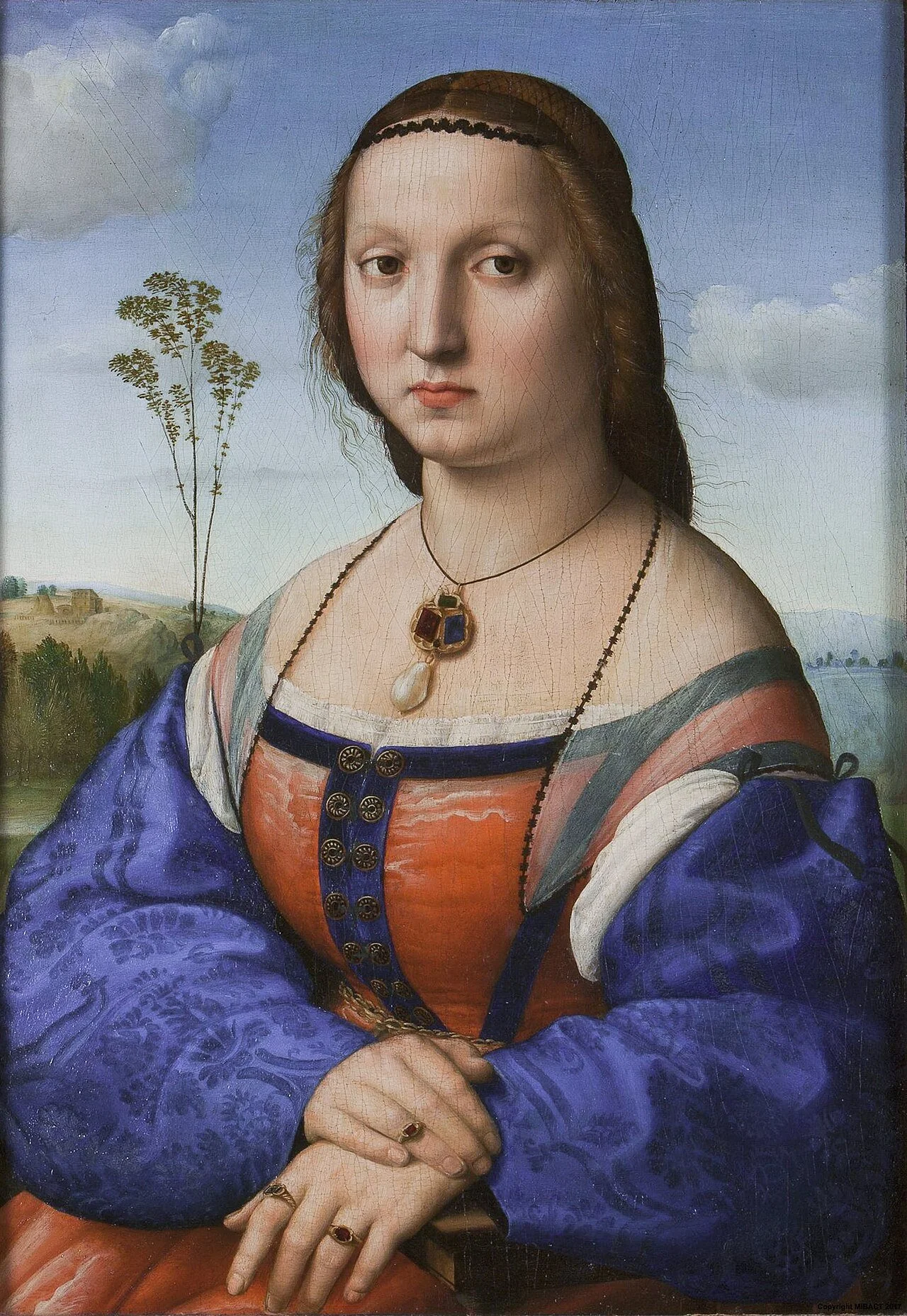
Raphael, Maddalena Strozzi Doni, ca. 1504-07. Oil on basswood panel.
The Uffizi Gallery (1912 nos. 61, 59)
Supposedly, Raphael arrived in Florence with a letter of recommendation from Giovanna Feltria della Rovere, sister of Duke of Urbino’s, to the gonfaloniere of Florence on October 1, 1504: “Sarà lo esibitore di questa Raffaelle pittore da Urbino, il quale avendo buono ingegno nel suo esercizio, ha deliberato stare qualche tempo in Fiorenza per imparare.”[1] Although the letter has been repeatedly challenged as a forgery by scholars since Johann Dominicus Fiorillo first raised doubts in 1798, it has nevertheless proved too important to let go of.[2] Like Michelangelo’s introduction to Rome, this letter gave Raphael a valid reason to arrive in Florence; he could not, at this moment, simply be an itinerant artist who showed up, enthralled by the Florentine art scene—the clash of two giants between Leonardo and Micheangelo, cumulating under Pier Soderini, gonfaloniere della giustizia, and his 1503 commission of the two masters to decorate the Grand Council Chamber walls.[3]
But the works that Raphael produced from 1505 to 1508 have often been read by scholarship, in effect, as a “study abroad” in Florence. His drawings reflected a concentrated period of study: Leonardo and Michelangelo above all, and also earlier Florentine masters such as Fra Bartolomeo at San Marco, where he could learn il suo colorire.[4] And the works he produced there—half and three-quarter-length Madonnas, along with portraits—trace a gradual artistic maturity that alternately imitated, surpassed, resisted, and finally learned to balance in the crosswinds of his two senior contemporaries.
Similarly, Raphael’s arrival in Rome in 1508 was unclear whether he was called in on business, as Michelangelo was by Julius II and Paul III, or showed up on spec, hoping to win papal commissions from the former, who was ambitious to make Rome surpass Florence as a political and cultural center.[5] Although, in retrospect, Raphael’s Roman portraits and his busy workshop schedule proved one thing: whether he arrived by summons or by choice, he quickly settled into careerist rhythm, building a network of clientele around the papacy and its adjacent circles. Already evident in the earliest work of this period, the Portrait of a Cardinal, painted around 1510, offers an idealized image of a cardinal, staged through the tactility and volumetric display of the red mozetta, a canon Raphael would later recycle in the Portrait of Cardinal Bernardo Dovizi (fig. 1). [6] Clearly, Raphael’s attention in Rome was directed more toward the context and intended function of portraiture than toward self-exploration or sitter’s individuality alone. He was attentive to the complicated social and political scenery in the papal capital.
To determine whether Raphael in Florence was a young pupil driven chiefly by curiosity, or already an artist responding to the city’s mercantile scene in a way that anticipates his Roman maturity, is to look through his Madonnas and Florentine portraits. Among the numerous Madonnas he painted in this period, many were likely made as quadri di spose, wedding images, and they found ready patrons among merchant families such as the Canigiani, Nasi, and Doni.[7] Yet no period responses survive for these works, unlike the public reception recorded for Leonardo’s St. Anne with the Madonna and Child. [8] And among the few portraits Raphael painted, or that can be attributed to his Florentine years, one picture invites relish: the Portrait of Maddalena Strozzi Doni, conceived as one half of a pendant pair with her husband, Agnolo Doni.[9] And her frizz comes first.
In the Portrait, the treatment of animation in hair departs from the stylized waves found in many of Raphael’s contemporaries. Rather than shaping the hair into wind-tossed waves, Raphael registers the air with fringes of ultra-fine flyaway strands. Each filament separates crisply against a sky of limpid blue with two clouds scudding across. So movement is suggested not by a theatrical gust, but by the slightest vibration of a perceptible presence. This minute attention to air suggests Raphael’s al fresco sensitivity, if not literally placing his sitter outdoors on an open threshold, possibly the balcony of Palazzo Doni. She wears a sumptuous gamurra of orange colored watered silk over the dress, enclosing tangerine with shades of blue. She turns slightly to the left in front of a wild hilly landscape while her husband, Agnolo, wearing a black doublet with wide red sleeves, long hair alla zazzara, on top a black bonnet, turns slightly to the right with his right hand resting on thigh and left on a balustrade, looking at the viewers with a searching look.[10]
X-radiographical study of the pendant pair shows Raphael reimagining the setting, shifting Maddalena’s from an interior scheme, conceived as a continuation of Agnolo’s vista, to her independent landscape (fig. 2).[11] He fashions a living surround that seems to breathe with the sitter, drawing the verdant distances of the world into the dormant painter’s corner. Taken together, Raphael’s decisions reject formulaic curtained backdrop, and bring Leonardesque gesture into his own clarity of light and jewel-toned naturalism. They also cue the next question: what, exactly, did Raphael take from Leonardo, and how did he arrive at this point?
To understand that we need to trace through the evolution of his Florentine Madonnas first: a series of at least nine works on the same subject, varied in their form, gesture, palette, and spirit (fig. 3-11). The Small Cowper Madonna was the starting point. It moved beyond Perugino language to show an interplay of figures. Madonna del Granduca added weight to the body through a chiaroscuro contrast against the dark background, making pictorial figures tangible. The Madonna of the Pinks, dated around 1506, was the beginning of Raphael’s break into Leonardo’s concept. In the Bridgewater Madonna, painted between 1507 and 1508, Raphael was able to show both the technicality of Leonardo’s noble gesture and the intellectual sophistication of Michelangelo’s twisting physicality. Both the Tempi and the Large Cowper Madonna were Raphael’s study of color, achieving a harmony of cool and warm, recalling his period under the school of Perugia but tones are more fully developed, the forms more rounded in a flowing contour, with a distribution of light that blooms on Madonna’s face.[12] Raphael’s larger scale Madonnas are often in three figures. The earliest one, the Madonna del Prato, dated between 1505 and 1506, shows the clearest pyramid form of Leonardo; Madonna del Cardellino was his experimentation with Michelangelo’s visual repertoire; and Raphael’s maturity cumulated at Belle Jardiniere, displaying a complete balanced dialogue with Leonardo and Michelangelo.[13] Although Pope Hennessey warned against chronology for Raphael, we can still see a spiraling progression of artistic maturity—sometimes forward, sometimes back—as he worked out which elements he could command and which he still felt insecure about.[14]
A second answer sits in Raphael’s explicit engagements with Leonardo’s inventions in figure studies. If his Madonnas were a study diary recording how his progress, his drawings would be the footnotes that show exactly how he broke away from Leonardo’s influence and created his own language. His early study of Leonardo’s Leda records the observation of a few escaping tresses, although still emblematic in its limited strands (fig. 12).[15] Raphael simplified Leonardo’s spatially sophisticated torsion by placing protagonists more parallel to the picture plane, and showed little interests in the ambiguity of sfumato that Leonardo utilized to render the complexity of life. The oversimplification was not incompetence but Raphael’s determined distancing from his seniors to keep his personal logic intact.
In three drawings related to the Portrait of Maddalena Doni, two of such were identified as possible preparatory works for Maddalena Doni. The British Museum drawing dating was debatable, some point to late Perugia period owing to characteristics of Perugino and some to early years in Florence, as it reflected a Florentine three-quarter portrait tradition derived from half-length profile portrait (fig. 13).[16] Both the transparent veil and the slash opening at her elbow showed resemblance to Maddalena’s dress, as well as another female portrait, Young Woman with Unicorn (fig. 14). The drawing in Lille was completed in a higher degree of rendering, but it is more formally related to the British Museum drawing than to any paintings (fig. 15). The female here is cut almost at bust, reminding the interchanging compositions Raphael utilized for his small and larger triplet Madonnas. And the Lille drawing shows clear signs of Raphael imitating Leonardo’s special smile with a mysterious aura.
The Louvre Drawing is elaborate with a shaded loggia, an entirely novelty in Raphael’s oeuvre (fig. 16).[17]Again there are traces of Raphael studying the pyramidal form and graceful expression of Mona Lisa. This drawing is also considered a preparatory work to both Maddalena and the Woman with Unicorn. Two loose strands of curly hair drip down, recalling Raphael’s study of Leonardo’s Leda. Maybe neither of these three drawings were preparatory; instead they could be Raphael’s investigation of formal possibilities of Leonardo’s compositional developments.
Maddalena Doni’s portrait shows the same tension between duality and duplicity of adoption and refusal. It seems like Raphael never translated everything he experimented in the drawings into the paintings. The melancholic and Leonardesque sentiments in both the British Museum and the Louvre drawings were toned down into dignified and unflustered expressions supported by a pyramidal noble gesture. In a sense, the Portrait of Maddalena Doni is the opposite of the Lille drawing. Hugo Chapman argued that the metalpoint Lille drawing shows a more sophisticated level of sfumato and “feline” quality in expression but Raphael was not yet capable of translating such technicalities into a more demanding medium of paint.[18] In Maddalena’s portrait, Raphael returned to the Mona Lisa concept with a renewed vigor, yet developed a different practicality for the sitter: Maddalena is anything but mysterious. She is direct. She is young, barely eighteen by yet portrayed unidealized with a slightly podgy face.[19] The candor physiognomy was against the contemporary Florentine tradition that drifted toward flattering generalization at the end of the sixteenth century.[20]
Agnolo Doni’s personality may help to explain why this tension between the unidealized and the idealized could be Raphael’s point of departure from Leonardo. Agnolo Doni was a wealthy Florentine citizen, a collector of antiquities, and a patron not only of Raphael but also of Michelangelo and Fra Bartolomeo.[21] His personality, especially the famous anecdote about bargaining over the price of Michelangelo’s Doni Tondo, has tended to reduce him to a thrifty type who balks at cost while recognizing value of art.[22] Then it is not hard to imagine Agnolo, in his businessman mode, asked Raphael for revisions. Whatever he requested—visible in the X-radiography of the reworked landscape and something else maybe—was likely a response to Florentine social expectations. The double portraits were mostly likely commissioned to celebrate Maddalena’s pregnancy. The allegorical scene painted on the reverse of Maddalena Doni makes that logic explicit: Deucalion and Pyrrha, after surviving the flood, threw stones behind them and generated a new race of humans—an unmistakable parable of fecundity.[23]
Could the flyaway filaments of Maddalena’s frizzy hair belong to the same revision program as the reworked landscape? This motif is not foreign to Raphael’s oeuvre. As the Leda study and the three so-called “preparatory drawings” suggest, escaping tresses slipping out from veils recur across his work, and they surface again in later portraits like the Donna Velata (fig. 17). What makes Maddalena unique, however, is the unsparing naturalism of hair that looks almost dried out—an effect that sits against the conventional ideals of female beauty. That awkwardness matters, because hair in the Renaissance was never a neutral sign. “Complex headdresses, beards, and the management of hair—long or short, washed or unwashed—were essential mechanisms for displaying status and position, sacred and secular.”[24] Maintaining hair required time, and was expensive; even washing carried medical anxieties, where warm water and steam were thought to open pores and alter temperament, so cleanliness became a practice of mediation rather than simple abundance.[25] Of course there were also governmental regulations and courtly cultures on hair. Venetian authorities legislated women’s head coverings and warned against innovating them while court letters treat hairstyling as a social obsession—Capilupi’s line to Isabella d’Este makes the curling of hair sound like a pastime.[26] Within that world, loosened or escaping hair was generally associated with young women: Florentine art toward the end of the sixteenth century, at a stage obsessed with idealized beauty, also gradually favored less control depiction of hair: from veiled to uncovered, from bound to lightly disturbed by air, and an almost al fresco manner that lets the body animate in the element.[27] A young Maddalena, on the other hand, was purposefully altered to display a stricter decorum of hairstyle and hairdressing that reflect maturity. Although it was unknown to Raphael, Leonardo noted observing figures painted by his mentor Verrocchio, who rendered strands by letting the charcoal barely touch the page, then pressing and lifting to make the line thin out from root to floating end. It was an optical analogue to the very phenomenon Maddalena displayed.[28]
Lorenzo de’ Medici once wrote “at the first sign of love, I saw her hair”—a line that refuses to tell us whether he fell in love first and then saw her hair unveiled, or whether he saw her hair and then fell in love.[29] In Maddalena’s portrait, we cannot be sure whether we see her first and then notice the floaty tresses, or whether the frizzy ends strike first to our eyes and only then we see her face. Raphael achieved both. Portrait, and its primary metaphor—people—are one.
[1] Jirí Siblík, Raphael, Drawings (3M Books, 1983), 3; Roger Jones and Nicholas Penny, Raphael (Yale University Press, 1983), 21.
[2] John Shearman, Raphael in Early Modern Source (1483-1602), vol. 2 (Yale University Press, 2003), 1457-61. Fiorillo thought “the terms of endearment unconvincing in the case a young man of twenty-one.” Pungileoni commented on the possibility that the letter refers to another “Raffaello urbinate pittore,” known from documents from 1554 to 1557. Rosini concluded that if the letter was not referring to another Raphael, then it was a forgery. In the twentieth century, Oppé and Wanscher noticed that the forger might consult Vasari. The line from the letter, “ha deliberato stare qualche tempo in Fiorenza per imparare” seems to derive from Vasari’s “venne in questo tempo Raffaello…a imparare l’arte a Fiorenza” ([1550] 603, [1568] II, 37).
[3] Jürg Meyer zur Capellen, A Critical Catalogue of His Paintings: Beginning in Umbria and Florence ca. 1500-1508, vol. 1 (The University of Michigan, 2001), 34. Leonardo returned to Florence in 1500. See Vincenzo Golzio, Raffaello (Città del Vaticano, 1936), 11.
[4] Jones and Penny, Raphael, 21.
[5] Siblík, Drawings, 3.
[6] Jürg Meyer zur Capellen, A Critical Catalogue of His Paintings: The Roman Portraits ca. 1508-1520, vol. 3 (The University of Michigan, 2001), 9; On Raphael’s earliest Roman portrait, The Portrait of a Cardinal in Prado, see Konrad Oberhuber, Raffael: Das malerische Werk (Prestel Verlag, 1999), 125.
[7] Capellen, Critical Catalogue I: Beginning in Umbria and Florence, 38.
[8] Giorgio Vasari, Le vite de’più eccellenti pittori, scultori ed architettori, in Le opere di Giorgio Vasari, con nuove annotazioni e commenti di Gaetano Milanesi, vol, 4 (G. C. Sansoni, 1879), 38.
[9] Capellen, Critical Catalogue I: Beginning in Umbria and Florence, 57. Only three female portraits were painted in Raphael’s Florence period. After Maddalena Doni, he painted La Muta and La Gravida (Pregnant Woman).
[10] Paolo Dal Poggetto, Raffaello: I Disegni (Nardini, 1983), 237. Gamurra is a kind of vest worn over the dress, sleeves are attached by bows, agugelli.
[11] Lauren Dodds, “Portrait as Metamorphosis: Reconsidering the Doni Portraits and their Verso Paintings” (PhD diss., Pepperdine University, 2011), 104, Plate 3a.
[12] Carl Friedrich von Rumohr and Julius Schlosser. Italienische forschungen (Frankfurter verlags-anstalt, 1920), 531. Rumohr considered the Tempi Madonna to have the closest stylistic resemblance of Maddalena Doni.
[13] Capellen, Critical Catalogue I: Beginning in Umbria and Florence, 37.
[14] John Pope-Hennessy, The Portrait in the Renaissance (Bollingen Foundation, 1966), 86.
[15] Capellen, Critical Catalogue I: Beginning in Umbria and Florence, 45. Raphael studied not only Leonardo’s Leda but also Michelangelo’s David. Florentine period was indeed a “time of study” to Raphael.
[16] Capellen, Critical Catalogue I: Beginning in Umbria and Florence, 56. Knab, Mitsche, and Oberhuber (1983) date the British Museum drawing to 1502-03 due to its resemblance of Perugino’s style. Gere (1962) and Joannides (1983) date the drawing to Raphael’s early Florentine period; Hugo Chapman, Raphael: From Urbino to Rome (National Gallery London, 2004), 144. Initially the sitter in the drawing was identified as Raphael’s sister but Passavant (1839) pointed out that she wasn’t born until 1494 and died as a child.
[17] Chapman, From Urbino to Rome, 176.
[18] Chapman, From Urbino to Rome, 144.
[19] There is no documents about the commissions, on Maddalena’s age when the portrait was painted, see Capellen, Critical Catalogue I: Beginning in Umbria and Florence, 56. Mina Gregori (1984) and Alessandro Cecchi (1987) argued that she was 18 when the portrait was painted. Maddalena married Agnolo in 1504 at the age of 15 and given that there is a pregnancy record of 1507, and there is no signs of pregnancy in the painting, the panel could not be later than the first month of 1507. Although Capellen rejected this theory because there could be a considerable timespan between the design and the execution of the painting.
[20] Lorne Campbell, Renaissance Portraits: European Portrait-Painting in the 14th, 15th and 16th Centuries (Yale University Press, 1990), 69.
[21] William Wallace, “Doni’s Double,” Notes in the History of Art 25, no. 4 (Summer 2006): 10.
[22] Giorgio Vasari, Le vite de'più eccellenti pittori scul tori e architettori: nelle redazioni del 1550 e 1568, ed.s R. Bettarini and P. Barocchi (Florence, 1966-1987), 22-23. The anecdote is following: “Now Angelo, who was careful with his money, was disconcerted at being asked to spend so much on a pic ture, even though he knew that, in fact, it was worth even more. So he gave the messenger forty ducats and told him that that was enough. Whereupon Michelangelo returned the money with a message to say that Angelo should send back either a hundred ducats or the picture itself. Then Angelo, who liked the painting, said: ‘Well, I'll give him seventy.’ However, Michelangelo was still far from satisfied. Indeed, because of Angelo's breach of faith he demand ed double what he had asked first of all, and this meant that to get the picture Angelo was having to pay a hundred and forty ducats.”
[23] Alessandro Cecchi, “Agnolo e Maddalena Doni committenti di Rafaello,” in Studi su Raffaello, eds M. Sambucco Hamoud and M.L. Strocchi (Urbino, 1987): 429–39.
[24] Evelyn Welch, “Art on the Edge: Hair and Hands in Renaissance Italy,” Renaissance Studies 23 (3): 260.
[25] Anthony Synott, “Shame and Glory: A Sociology of Hair,” The British Journal of Sociology, 38 (1987): 381.
[26] Welch, “Art on the Edge,” 270. Marin Sanudo, I diarii di Marino Sanuto, reprint (Bologna: Forni editore, 1969-70), 58, col. 108: 8 May, 1533; Alessandro Luzio and Rodolfo Renier, “Il lusso di Isabella d'Este, Marchesa di Mantova: accessori e segreti della ‘toilette,’” Nuova antologia, 65 (1896), 666: Benedetto Capilupi to Isabella d'Este, 3 February, 1505.
[27] Edith Snook, A Cultural History of Hair in the Renaissance (Bloomsbury Academic, 2022), 68.
[28] Emanuele Lugli, Knots, or the Violence of Desire in Renaissance Florence (The University of Chicago Press, 2024), 11.
[29] Lugli, Knots, 38.