Odilon Redon
ca. 1895-1905
With Closed Eyes
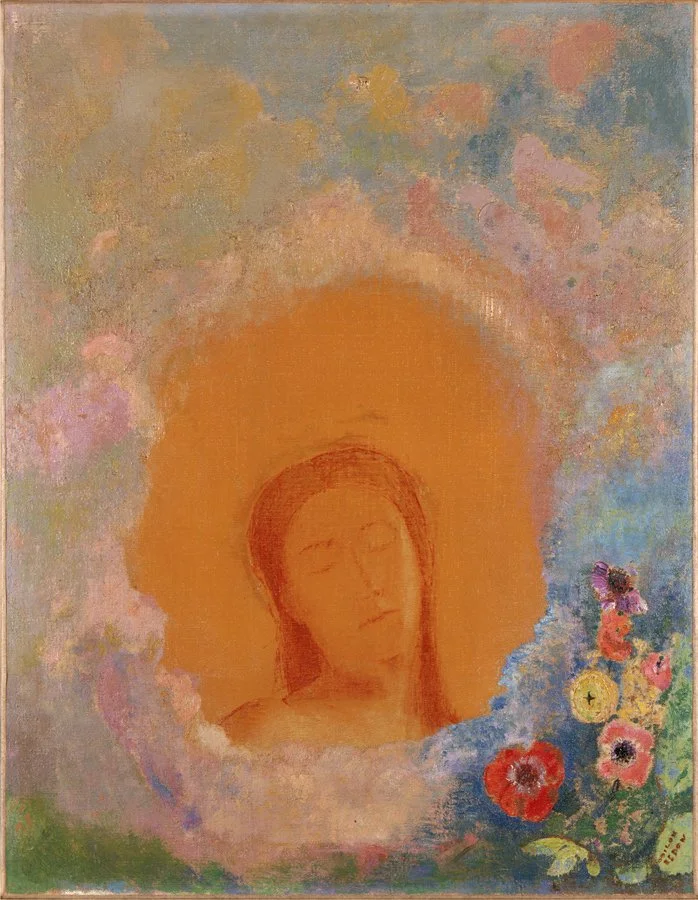
Odilon Redon’s With Closed Eyes first appears to me as a relic on a surface marked by time—a foxed shroud carries the faint outline of a woman, adumbrated with tentative, preparatory lines, as if a sanguine underdrawing on vellum had been left languished unfinished and exposed by time. Around her, festooned by a dense, evanescent inflorescence, this work of art, or rather an artifact of an unknown time, attests to a slow fading, a corruption that seems to radiate outward from the center, every which way. Yet within the space of the canvas, unbidden, I cannot help but question the spatial relationship between the woman and her blossoming surround, where the depth of paint accrues apace with the intensity of colors, making the woman appear from behind. But is she?
That intuition of her appearing through from behind rests largely on this discrepancy of color and saturation. The chromatic intensity and heaviness of the flowers overtakes the pale, historicized outline of the woman, pushing her visually backward. Sharpe but short white linear traces along the upper right edge of this aperture, conspiring with the vertical grain of the canvas, stages a floral grotto behind a cascade, of water or of light scattered in Tyndall effect, where the voyeuristic gaze seems both on her and from her, even as her eyes remain closed (fig. 1).
Yet this architectural reading of the pictorial space collapses as soon as one steps back. Redon’s uncalculated brushwork refuses distinction of depth between foreground and background. The woman, then, rather than being read as a person behind an overgrown recess, might also be the vellum on the same pictorial plane as the fauna and flora, or slightly under, encroached by the paper weight of wreath with toothed blue lines beside the purple poppy that echoes the white ones higher up (fig. 2). Or even in front, the crepuscular blot of her, is a watercolor dropped accidentally onto a field of blue vegetal form.
What emerges from this canvas instead is a peruse of the painting as a thing: a rectangular object composed of marks, pressures, and material decisions. Not just Redon’s brushstroke, but also the drag of pigment, the resistance of the canvas, the fading and cracking of color, these chemical or physical conditions are not formalism in the narrow sense, but a microscopic insistence on the objecthood, the object that was produced, embellished, collected, archived, and now displayed at the SCMA.
Zooming out from the scrutiny of this painting’s materiality, I then notice the tilted signature, following the whirlwind of the vegetation, itself a trace of motion. Further away, as colors blur into blocks, the green mass in the lower left corner transforms from foliage into a forestry landscape of undulating hills, making the canvas a collage of near and far. Redon’s style invites precisely this kind of reverie. His surface holds viewers in a state of oscillation between figure and abstraction, image and object, subject and material components. So, is it even relevant to ask who the woman is? Placed by the entrance of the third-floor gallery at the SCMA, this work should not be for a quick look; it instead belongs to a pan-art historical niche, together with works that are at once relics or made to appear relic-like, for a long meditation on the materiality of art, for a slow weathering of oil on canvas.